UPSIDE DOWN. Challenge the status quo.

Katarzyna Rząsa
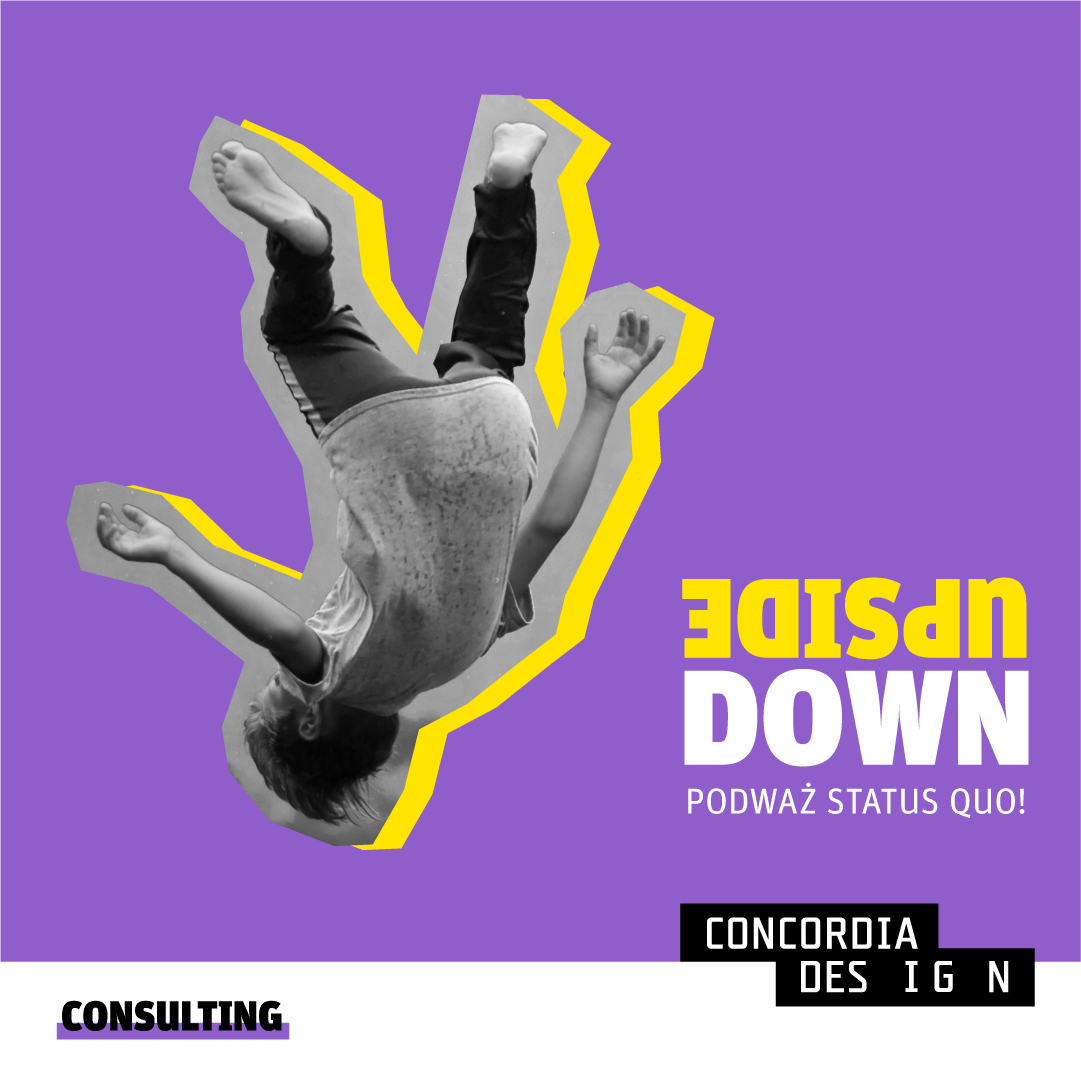
"After all, somehow it works""It's not for us and our customers", "Everyone does it"... Sound familiar? Today I'm inviting you to the UPSIDE DOWN abecademy. I'll tell you why, from my perspective, it's worth challenging the status quo and looking for non-obvious solutions, and sometimes, as if on a whim, look at our challenge from a different perspective.
And how analogies
A technique to look for inspiration in other brands - when describing brands, we often refer to the emotions, qualities and values they give to their customers. In this exercise, we choose brands that we would like to be inspired by, or brands that we feel might be (or know from the empathization stage that they are) close to the user for whom we are designing solutions. Then we consider what the brand gives its customers in terms of experience or amenities, what users like and value it for, and finally we try to find an answer to the question of what we could do to give our users what the brand gives them.
B for research
Quantitative research comes to mind for most of us. I encourage you to do qualitative research. Why? We do quantitative research to learn about the scale and prevalence of phenomena, and qualitative research to understand them. So they can turn our thinking upside down. they allow us to gain a deeper understanding of the phenomena, behavior and opinions under study. For example, they can help understand why people make certain decisions or what their motivations are, but also blockers and fears.
D as adapting to the changing business environment
Remember the NOKIA story that claimed phones would never be touchscreen?
The business world and technology are constantly evolving. Organizations that stay with old solutions and processes can find themselves at a disadvantage. Challenging the status quo helps companies adapt to new trends, technologies and challenges.
E for efficiency and productivity
Sometimes old processes and practices are not optimal. By analyzing and challenging the status quo, organizations can identify areas where operations can be improved and efficiency increased.
G for working group
It might seem that a team consisting of the best employees of an organization is an ideal team. After all, the very experts in such a team are maximally efficient, effective, creative and deliver the best results. In short, a team that is every leader's dream. Well, no! A diverse team is more productive and creative, and it is easier and more willing to go beyond the usual patterns. Conclusion: invite people with different seniority, experience, with different perspectives to the working group. Invite people from the market, users, and even...children.
And how innovation
Stagnation can lead to a loss of competitiveness. Making changes and innovating allows an organization to create new products, services and processes, which can help gain a competitive advantage. This cannot be done without getting out of your comfort zone.
K for creativity
Approach generating solutions like a good workout. Start with a warm-up and then add more exercises and elements. Keep in mind different techniques and methods. Collect different, even the seemingly craziest ideas. This is not the time to kill, but to nurture madness and courage! We have already taught more than one team how to train and it works!!!
N for extraordinary_a
Imagine that your project team is joined by...let's say person X - Extraordinary_a well-known, distinctive and charismatic person. What perspective does he bring, what experience from his business/industry does he offer to answer the challenge? And what if this person were our customer - what solution would we want to design for them? How do we choose the personas? As the facilitator of the creative session, you can impose well-known figures on the group in advance, e.g. Madonna, Anna Lewandowska, Elon Musk, Janina Bąk - the sky is the limit! In this case, individual groups draw lots to see who joins their working team. You can also ask the group to choose a character they would dream of having join the working group or be the recipient of the solution. This technique opens us up to another pool of ideas, we once again exercise empathy and generate non-obvious solutions.
P for psychological safety
Without it, you can't move! The level of psychological safety affects how ideas are expressed, received and transformed into action. Nurturing psychological safety can create a more conducive environment for creativity and innovation in the workplace. So if you catch yourself thinking "my employees never have any ideas," perhaps it's time to consider whether they actually feel open to different viewpoints and different ideas.
W as WHY.
Ask yourself why I am creating a product a service. What purpose does it serve. What rational needs does it fulfill? And what emotional ones? How should the person using your solution feel?
Z as start with yourself.
Time for self-diagnosis. And when have you done something different than usual?
Where do you start 😉
Good luck!