

What is Persona and how to work with it?

Agata Korczyk

Persona is one of the basic tools used when designing products, services or brands to visualize their audience. It is also the flagship tool used in the Design Thinking method. Despite its popularity, it is not an easy tool. Some people consider the classic persona to be outdated, impractical and abandon it in favor of other design tools. Whether it is worth working with it and how to do, create it wisely so as not to burn through the potential of this tool and avoid mistakes - about this below.
HOW AND WHY DO WE WORK WITH PERSONAS?
The persona is supposed to reflect a certain defined audience of our solution. It should be representative of a certain set of customers, or users, who are characterized by a given context, problems, or motivations.
First of all, it is important to distinguish between a protoperson and a persona. A protoperson is usually created by brainstorming by the project team and it is based on assumptions, experiences, anecdotes, pre-collected information. This means that such a protopersonona is usually done at the beginning of the design process, as a starting point for further activities. The assumptions made in the protopersona are also the basis for the definition of research hypotheses to be verified. A protopersona alone may not be sufficient to design a solution that meets the needs of our audience.
Ultimately, persona is based on the results of qualitative and quantitative research. Persona is therefore intended to reflect the conclusions and data from these studies and depict phenomena, behaviors or motives that are repeated or similar in the case of the people studied. These conclusions can be gathered primarily through interviews with users, that is, individual and group interviews, but also ethnographic research and field observation, netnographic research (on the Internet), during testing and using many other research methods.
Personas are most often created for the audience that is most important to us - the largest or the one that generates the largest share of revenue. Personas are mostly not created for unitary audiences, unless niche groups are important to the business model.
The most important argument, then, for working with personas is that the data they contain is objective, real, taken from research and stripped of subjective assumptions. Therefore, translating it into a certain image of the recipient's persona greatly facilitates the work not only of product or service designers, but also, for example, of other members of the team delivering value to the customer, e.g. those in service, marketing and communications, advertising, sales, etc. It allows you to step into the shoes of the recipient and ultimately reach them better.
MOST COMMON MISTAKES
- Persons are created exclusively by the project team.
Overlooking the participation of other people appearing in the customer's path, especially those who have direct contact with the customer and know his needs, problems and motivations (e.g., salespeople, customer service) can lead to a narrowing of the perspective of service or product designers and a failure to capture relevant information.
- Persons contain data that is unnecessary or inadequate for the scope of the problem that is the basis of our analysis.
A key challenge for a persona designer is what data to present. A persona can very easily be shallow, generalized, which can lead to stereotyping. It is also very risky to describe it in too much detail, for example, by including most research findings or data that may not be relevant to the problem being solved.
- Persons coinciding with expectations and created "under" the solution.
This is a risk that occurs especially in cases where the product or service already exists, rather than yet to be designed. It can result from being attached to a solution and tailoring the description of the persona to fit the profile of the ideal regular customer, overlooking relevant research findings in the context of the problems faced by these customers. This situation can also be caused by relying on beliefs rather than research findings.
- Persons focusing mainly on personal and character traits, family or work situation or demographics that have a given task to perform and a goal to achieve.
Omitting behavioral information about, for example, ways of doing things, thinking and decision-making patterns, motives for action, fears, pains, expectations, ways of communicating and obtaining information and the emotions that accompany this can result in a target solution that may not be seen and understood by the entire target group.
PERSONAS TEMPLATES - IS IT ALWAYS A GOOD IDEA TO FOLLOW THE AVAILABLE TEMPLATES?
There are many different templates available online for filling out a persona. However, it is important to remember that not every piece of information may be necessary for the context and design challenge. So each time, you should think about whether a particular field in the template can really make a difference in what product or service solution you use.
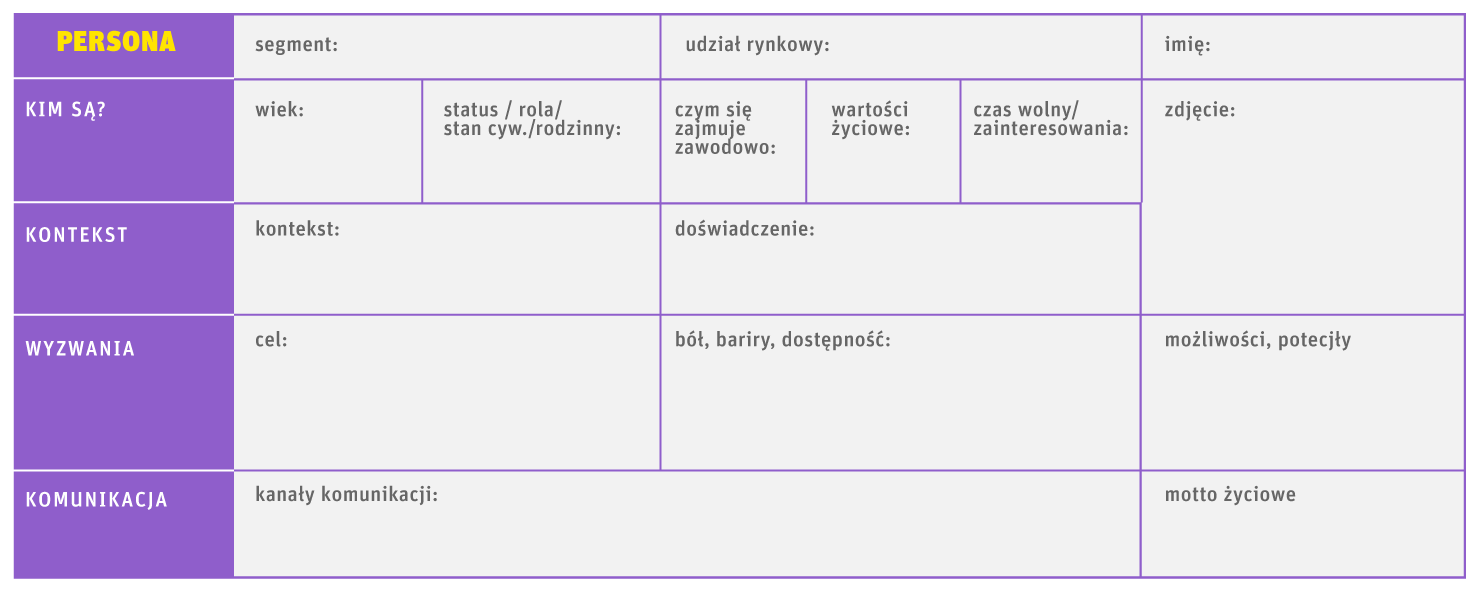
Fig. Persona template including classic elements
There is a lot of discussion about providing personal data, demographics, age, gender, location, etc. It's worth considering what this means in terms of the challenge our prospect faces, the task at hand and the desired benefit they want to achieve. Does it make sense to state that our average recipient is male, 26 years old and lives in a city of >100,000 residents? Yes - if we know him very well and such narrowed data clearly stands out in the research. No - if our target audience might as well be a person with different demographic characteristics, but facing similar problems, with similar motive for action and behavioral patterns. So, in the first place, it is worth thinking about behavioral segmentation instead of demographic segmentation.
Another controversial field is BIO - a brief description of the persona with the history that led to the moment they are in. This can be relevant when our users mostly share a similar path of past experiences. It may be of greater analytical value, for example, to describe how a persona falls into different patterns of thought and behavior
Does a persona have to have a name? A name causes us to look at a persona as if it were a real person, better to step into their shoes. An approach that breaks this pattern is to create and use a user archetype. Conducting research will identify key archetypes that best reflect the various target groups of a product or service. For example, these could be archetypes like "Explorer," "Problem Solver" or "Social Maintainer." Next, it can be helpful to identify the ways in which the archetype uses the product or solution, its goals and challenges.
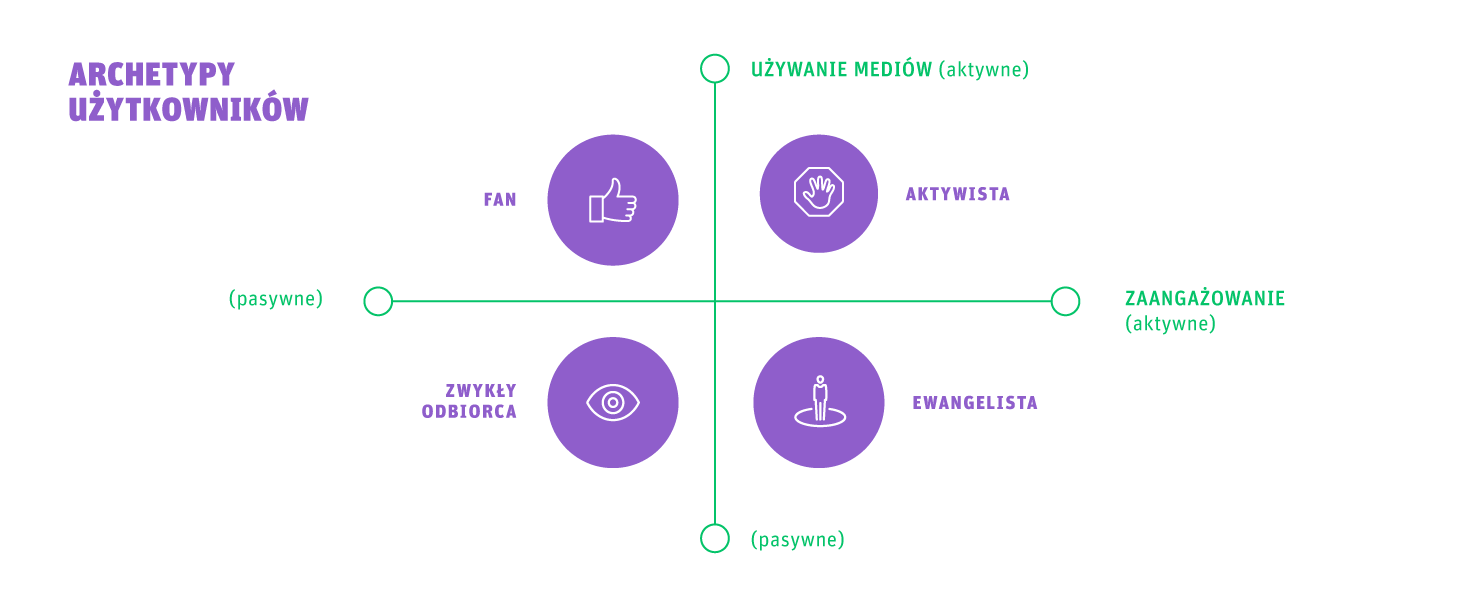
Fig. by Concordia Design based on
Source: https://medium.com/typecode/the-problem-with-personas-b6734a08d37a
Should you always provide demographic data? That depends on whether they are meaningful, for example, in terms of product or service usage or user outreach. Behavioral segmentation can be helpful in creating a persona and analyzing the relevance of demographic fields . This is one type of market segmentation that is based on analysis of consumer behavior and actions. Unlike traditional demographic or geographic criteria, behavioral segmentation focuses on how people react to and use products or services. It covers various aspects of customer behavior, such as buying patterns, brand preference, loyalty, stages of the buying process, frequency of purchases and others.
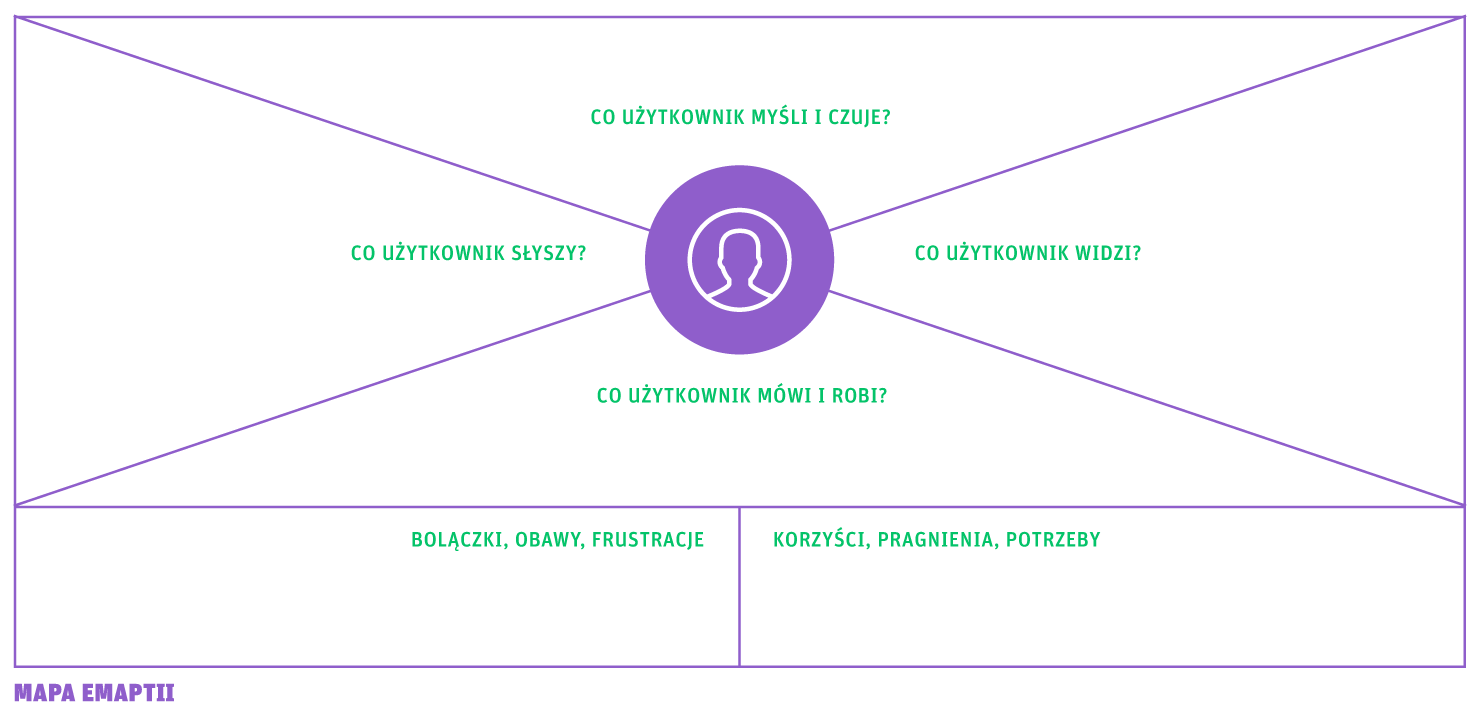
In addition to taking into account behavioral aspects, it also becomes important to describe emotional aspects, e.g. what concerns she has, what blocks her, what motivates and sets her in a positive mindset. An extremely useful tool for this, which can be completed in parallel with the creation of a persona, is an empathy map, which combines both emotional (what she thinks and feels) and behavioral (what she says, what she does) aspects.
FLEXIBILITY IN CREATING PERSONAS
In conclusion, personas authors do not have to, and even should not, lock themselves into rigid frameworks and design templates. However, it is worth taking responsibility for who creates it, who will use it and whether the data presented is valuable, realistic and up-to-date.
Creating a persona is a dynamic process. The market and user preferences can change, so it is important to regularly update personas and strategies with new information and trends.